From green transition to global stage: Armenia’s biodiversity moment
In the context of the Green Agenda for Armenia, Georgia, Moldova and Ukraine (GUMA) project, IUCN delegation visited Yerevan in mid-June to contribute to the launch of the National Comprehensive Green Transition Assessment Report for Armenia and deliver a public talk at the American University of Armenia (AUA) on the country’s upcoming role as host of COP17 under the Convention of Biological Diversity.
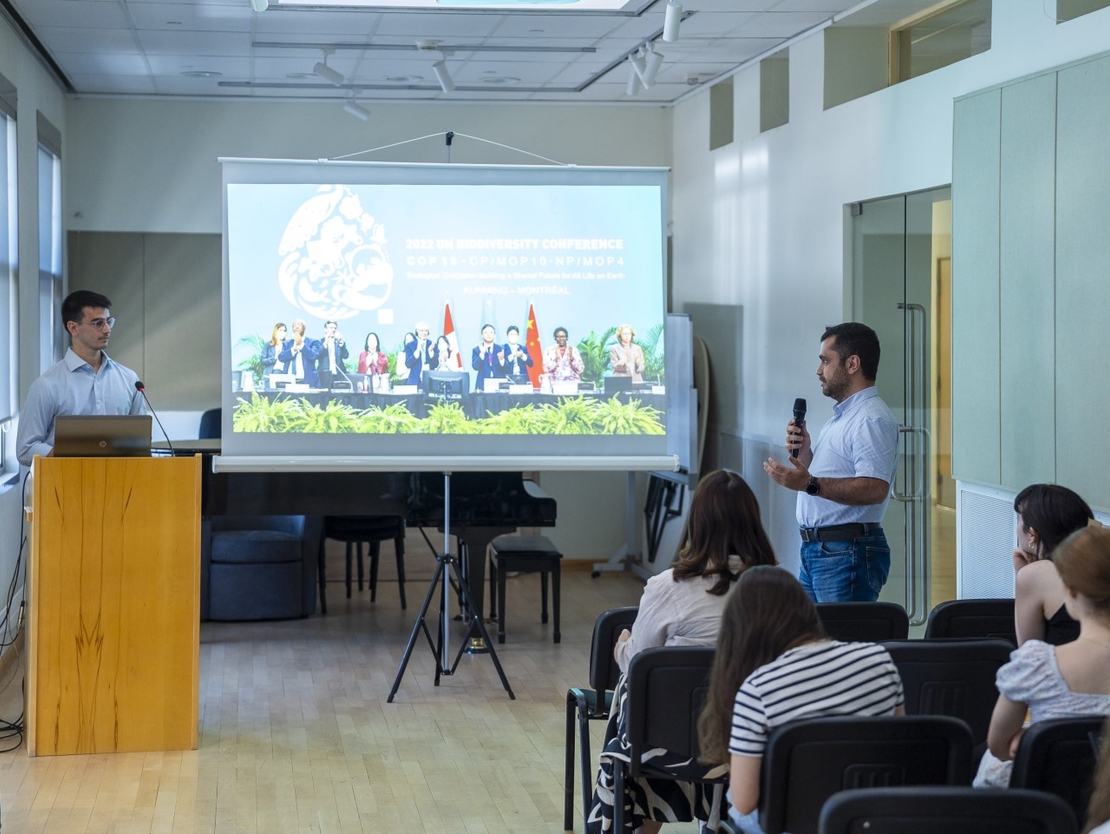
Tommaso Demozzi, IUCN Biodiversity Policy Officer, delivering a public talk at the American University of Armenia (AUA) in Yerevan on the role of Armenia as a host of CBD COP17
“What if COP17 in Yerevan is a failure?”. After a lengthy presentation on the importance of environmental diplomacy and cooperation, this was not the question I was expecting. I had prepared to offer insights on the details of the Global Biodiversity Framework, on the importance of the biodiversity section in the National Comprehensive Green Transition Assessment Report for Armenia, or the latest developments in European policy. Certainly, I was less prepared to tackle such a question.
A few seconds later, that felt like days with the eyes of students pointed towards me, I muttered: “I don’t think it can be”. Rather than an over-optimistic take on the meeting scheduled for 2026, this was an attempt at reframing the premise of the question. Nowadays, we are often asked to offer a binary response to everything, it’s either black or white. A failure or a success. The space for the grey seems to have been forgotten. Yet, it is the key as it provides nuances, shades, and most importantly, a place where divergences are discussed.
In the same way, we see the meetings of the Conferences of the Parties (COPs) as isolated events with only binary outcomes possible, and we judge them based on the progress made in those few weeks when they take place. The reality is quite different. COPs are just stepping stones in a long, continuous, and cyclical process. What is fundamental is the intersessional period, that liminal space where much of the work is being done and that is heavily underreported by the media. It's over years, and not over weeks, that confidence is built amongst parties and that civil society organisations’ capacity can be developed to support the translation of international policies to real change on the ground.
The conference hosted by the American University of Armenia in the context of the GUMA project is the perfect example of this. Over the course of two days, representatives from different ministries, national and international experts, students and citizens discussed the progress made on the green transition in Armenia in several sectors.
As IUCN, we focused primarily on the Biodiversity and Ecosystem section of this very comprehensive report. The analysis of this area of work highlighted the progress made in the country, notably in preparing the updated NBSAP (National Biodiversity Strategy and Action Plan) in the context of the Convention on Biological Diversity, and in establishing the EcoPatrol Service to strengthen implementation of the environmental rule of law.
At the same time, the conference and the report underscored key priority areas where action must accelerate. Firstly, the need to continue working on aligning Armenian legislation with the CEPA (Comprehensive and Enhanced Partnership Agreement) between the EU and Armenia, as well as with the EU Birds and Habitats Directive and the EU Nature Restoration Regulation. The GUMA project plays a central role here. Through scientific expertise, policy support, and access to global conservation tools, GUMA helps accelerate countries’ green transition in line with relevant EU policies.
Another key topic discussed was the expansion and strengthening of the network of protected and conserved areas, including OECMs (Other Effective Area-based Conservation Measures). The goal is to further support the establishment of the Emerald Network in Armenia, contributing to the country’s efforts to meet the global 30x30 target, protecting 30% of land and sea by 2030. Yet, it is not only quantity that needs to improve, quality of the protected areas management is also essential. This is where the IUCN Green List of Protected and Conserved Areas can serve as a valuable tool. It provides an international benchmark for quality that motivates improved management effectiveness and achievement of conservation objectives. Built around seventeen criteria, it describes the efforts needed to fully achieve the global Sustainability Standard and can be adapted to local contexts.
The need to update the Red Book of Armenia and establish a more comprehensive biodiversity monitoring system also emerged as urgent priorities in the assessment. Here, Armenia can also benefit from adopting the IUCN tools and standards, such as the IUCN Red List of Threatened Species and the IUCN Red List of Ecosystems.
Throughout the day, national experts also brought forward issues that they considered a priority, including the restoration of Armenian forests, environmental education, tackling pollution in Lake Sevan, and fighting wildlife trafficking. Occasionally, citizens took the floor to voice their concerns about the lack of green urban areas and even about the too many parking spots in Yerevan, offering a glimpse of how environmental action is perceived in their everyday life.
Going back to the question “What if COP17 in Yerevan is a failure?”, I still believe that it cannot be. All the participants at the conference had one thing in common: the unwavering will to showcase Armenia’s commitment to becoming a key player in the international environmental arena. Once again, reflecting its long history, Yerevan will become a crucial crossroads where people from all over the globe come together.
IUCN stands ready to support the country along the way, by offering trusted scientific tools, policy expertise, and platforms for cooperation across sectors and borders. A milestone on this path will be the IUCN World Conservation Congress in 2025, where the international community will gather to discuss how to align efforts and strengthen cooperation in the lead-up to COP17.
I hope to return soon to visit more of the country’s incredibly varied ecosystems, and to once again taste their sweet Prunus armeniaca.
Learn more
The Green Agenda for Armenia, Georgia, Moldova and Ukraine (GUMA) project is funded by the Swedish International Development Cooperation Agency and led by the Stockholm Environment Institute (SEI). GUMA unites government actors and expert partners from Armenia, Georgia, Moldova, and Ukraine to accelerate green transitions. By supporting policy reform, innovation uptake, capacity building, and investment, the project advances greener economies and resilient societies. IUCN contributes as a key partner on biodiversity, providing scientific and policy expertise to guide nature-positive action.
A personal thank you goes to Alen Gasparian Amirkhanian, Arsen Gasparyan, and Haykanush Martirosyan for their hospitality and the excellent collaboration in this project.
Disclaimer
Opinions expressed in posts featured on any Crossroads or other blogs are those of the authors and do not necessarily reflect the opinions of IUCN or a consensus of its Member organisations.